Showing posts with label literature. Show all posts

Tuesday, 22 November 2016

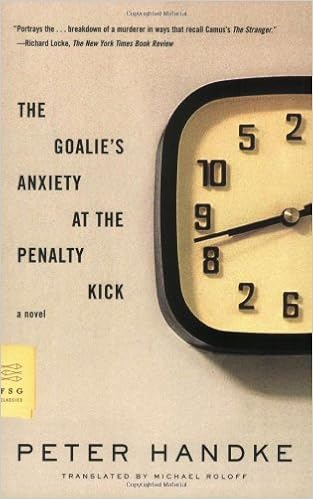
On Handke's 'The Goalie's Anxiety at the Penalty Kick'


Handke's book, The Golie's Anxiety at the Penalty Kick, (in original German Die Angst des Tormanns beim Elfmeter) was not a relaxing (entspannend) one for me to read. The book is depressing, very realistic, and follows the prolonged mental agony of its protagonist. The main character whom we follow, called Bloch, is a former goalkeeper. He has lost his job and can't find his place in the world. The novel documents how he loses his connecting with community, and how he can't find his place in the world, leading him to perceive his surroundings more and more absurdly.

We learn from the novel that Bloch's career as goalkeeper had its ups and downs, although he played for a big club, and he loses the job that he is doing after his retirement from football. He is divorced, not talking with his child, and has no money. As we could say, he is in a very bad position.
https://images-na.ssl-images-amazon.com/images/I/51VtOEQDUUL._SX311_BO1,204,203,200_.jpgHe commits a crime, but that's not what triggers the process of his losing his ground. Rather, it is a result. As Bloch realizes that he lost most of the important things that constituted the main frame of his life, he tries to cling on to smaller joys and habits: going to the cinema, getting drunk, picking up girls, going to his favourite bars. But nothing helps. Without a proper life within which these activities would have their place, within which they would give him pleasure or pain, they would be bad or good, would make him jump or feel guilty, they don't offer anything, just more of the same bleak grayness.

Bloch eventually ends up in a small village near the border. Initially the reader is tempted to think that he wants to flee across the border to escape punishment for his crime. However, Bloch is too passive and confused. When exploring the countryside around the little village in the direction of the border he starts thinking about the geometrical properties of the location, perspective, unexpected encounters, and space. Seemingly all could be related to planning an escape, but Bloch's thoughts drift far from making practical arrangements. The only time he appears to find some peace is after he gets extremely drunk, provokes a fight in a pub, gets beaten up, and then just sits at a table in the tavern with a beer, half awake and half asleep.

Bloch is not obsessed with his crime as Dostoevsky's Raskolnikov in Crime and Punishment. He is much more like the narrator of Camus' The Stranger/The Outsider. Someone who hasn't found any attachment in life, and is unwilling to invest the needed energy, emotion, and commitment to care. Without the needed emotional connections, without valuing things, he drifts, and gets into situations which could have been easily avoided. Bloch is somewhat more active, more of an agent. But an agent without much direction. It is obvious that he is a middle aged, energetic man, who is used to action. A normal, confident grown up. But without aims he just steps into situations, but then fails to see why they would matter, what would be their significance.

http://diepresse.com/images/uploads/6/f/f/1320703/handke_bdquoaeussern_durch_nichts_peter_handke20121205193204.jpg

Peter Handke

In the novel's closing scene Bloch tells the story of a goalkeeper who thinks so much about where the striker is going to shot the penalty that he is eventually rendered motionless, stands still in the middle, and the striker - expecting the goalkeeper to jump to one side - shoots the ball in his hands. Bloch is similarly unable to move. His thoughts throughout the novel run in all directions, usually into usually abstract, depressed and disattached directions. He persistently fails to find significance in anything. Whether he ends up with the ball in his hands? Unlikely that this would work the same way in the real life. One cannot be always lucky.

In many ways this is a sad tale of a middle aged person, who finds that he doesn't have the imagination, the will, and/or the energy to start life anew. He doesn't know how to build up again a network of caring relations, how to relate to people he has lost and should forge new types of relations with - his ex-wife and child - and what he should do with his life. The drifting highlights that since what he was good at he cannot do anymore - he is too old to go back to professional football - and he doesn't have any other genuine interests or connections, he falls apart, inflicting tragedy and confusion on others, as well as himself. We could understand the novel both to highlight how sad life is for many, and also to underline the importance of cultivating a genuine personality, capable of existing alone, with genuine interests, valuing things and people for their own sake. That is what enable most of us to survive continuous change in our life, and even very difficult times.

Sunday, 13 November 2016

Masuji Ibuse's 'Black Rain'

I've just finished Masuji Ibuse's 1969 novel Black Rain. It is an excellent novel. It presents the story of a small family from a village near to Hiroshima a few years after the atomic bomb was dropped on the city. The tone is - as in several the works of many Japanese writers - very matter of fact, and giving a good feel of the character of the storyteller, Shigematsu Shizuma. Despite the sometimes dry tone in which what was seen is recounted, Shigematsu's genuine concern for friends and family shines true at the important points. Ibuse's book offers some very dramatic turns which can be felt in full force. It is emotionally moving, and tragic.

It mainly deals with how radiation effect crept up years after the bombing on many of those who thought they would be fine, they would survive. It was interesting to read the book in the same year as Svetlana Alexievich's Chernobyl Prayer. Both books tell stories of loss, of patriotic or nationalistic feeling that motivated people to help and work among the debris of nuclear catastrophes, and the tragedy of not knowing what they were dealing with. At the time the nuclear bomb was dropped on Hiroshima the Japanese - including doctors - had no idea about the effects of radiation, and at the time of the Chernobyl catastrophe the masses of people living in the regions affected, as well as those who were sent there for relief work were kept in the dark about those effects. Both books tell about much suffering, but also about remarkable cases of community spirit and a feeling of belonging to the places, even after they have been affected by catastrophes. Of course the Japanese - with the help of the U.S. - dealt with Hiroshima and Nagasaki following the war was very different from the way in which Moscov - and Belarus and the Ukraine - handled the consequences of Chernobyl.

Ibuse's book mentions criticisms of the Japanese Imperial government, army, and navy only in a very subdued way. It is hard to guess today whether this is a literary tool employed by the writer to express that people were genuinely afraid to criticise the leadership and the army, even at the end of the war, or simply a reluctance to engage in such criticism when he wrote the book. What makes the former interpretation more likely is that in some places in the novel there is a marked contrast of descriptions of malpractice, mistreatment of civilians and soldiers by the military, still people who are obviously aware of the ridiculousness of what was going on are silent. The horrible plans of the army to arm all civilians to defend Japan against the invasion of the U.S. forces is mentioned in several places - in no way favourably -, also showing that there were people who genuinely believed - or at least talked as if they would believe - in such policies.

The book is another great argument for never again wanting a war and strictly keeping away from using nuclear weapons ever, in any situation. This makes it an especially relevant book to debates today, when the Russian military publicized in the last years that it carried out practices for scenarios of nuclear strikes against European targets, and where the false rumour was spread that the U.S. was threatening Russia with a nuclear war (this is supposed to have been averted by the election of Trump).

Russia is obviously at a point where it is under huge international pressure, and it Putin, his government, and his generals are willing to go to great lengths. Novels like Ibuse's and Alexievich's can help people understand in Russia, the U.S. and everywhere else, that threatening with nuclear strikes is a horrible thing to do, and any use of atomic bombs that affects civilians is a terrible crime. Tension and Russian propaganda need to be defused. Merkel and Obama have gone to great lengths to achieve this. However, Putin is willing to risk much, and Trump is fool enough - so it seems at the moment - to go along with his games.

You can read a review of Black Rain from The Japan Times here.

Sunday, 23 October 2016

What to read next?

When I'm finished with a batch of books I need a few days when I just work and don't commit to a new schedule of books. I usually start reading 1-2 handbooks, research books, nonfictions, and 1-2 novels, collections of poems or short stories roughly at the same time. Depending on how busy I'm it takes me a few weeks or 1-2 months to get through them (or as with the Karamazovs three months, but to be honest I've read 6 other books meanwhile).

Do many of my readers read this way? Or do you try and focus on one book?

The last batch of books I read consisted of the short stories collection War Stories edited by Sebastian Faulks and Jörg Hensgen, Dostoevsky's The Karamazov Brothers, Michael J. Sandel's What Money Can't Buy, Akiko Hashimoto's The Long Defeat, and Ogura Kazuo's Japan's Asian Diplomacy, and Hugh de Sélincourt's Oxford from Within. (The links point to reviews of the books or their publishers' pages.)

Besides doing my regular philosophy re-reading (Rousseau's The Social Contract, Aristotle's Politics, Anscombe's Intention, and Hornsby's Actions), I'm considering some of the following non-philosophy books:
Melville's Moby Dick,
Owen Jones's The Establishment,
Peter Frankopan's The Silk Roads,
G. R. Evans' The University of Oxford: A New History,
Heinrich Böll's Frauen vor Flußlandschaft,

Anne Enright's The Green Road,
David Steeds and Ian Nish's China, Japan and 19th Century Britain,
and
Jeffrey N. Wassertstrom's The Oxford Illustrated History of Modern China.

I don't want to start more than 3-4 books now, and I wonder which ones would go well together...Any advice or tips, as well as recommendations along these lines are welcome!

Wednesday, 19 October 2016

Hugh de Selincourt's 'Oxford from Within'

I've just finished the a nice old edition of Hugh de Selincourt's Oxford from Within. The book is short and readable, although the style is fairly outdated and at times very circumstantial. It is about an imagined journey the writer takes in Oxford, and an internal conversation between his positive and negative  memories and opinions of Oxford. In the end the good opinions are overwhelming, and much of the more condemning criticism is written down as understandable ideas of the author's younger self.

The book is nice, if one is in a dreamy mood. However if you hope to get some real insight into the workings or student life of Oxford don't choose this book. Besides some nice description of mostly known things and a few additional details you won't find much new information. The freshest and clearest parts of the book are - somewhat surprisingly - the sections praising the changes that women were allowed to study at Oxford, and that science and the classics were achieving a complementary position (something that has changed a great deal since the early 1900's when de Selincourt was writing).

The book - at least the older hardcover edition published by Chatto & Windus in 1910 - features some lovely paintings by Yoshio Markino, who lived and painted in London for a long time. The pictures bring to life how Oxford looked a 100 years ago. They are very atmospheric, complementing the text well. As someone who loves the places depicted - Trinity's gate, the front of All Souls and the Radcliffe Camera, Iffley Church, New College Tower - these pictures are really heartwarming.

http://www.artnet.com/WebServices/images/ll00811lldPx6FFgOKECfDrCWQFHPKcEzK/yoshio-markino-the-turl,-oxford.jpg

Yoshio Markino's rendering of Turl Street and the tower of Exeter

All in all, I would recommend this to someone who hasn't yet read much about Oxford, and who wants an easy reading that can be finished in one or two afternoons.

Friday, 14 October 2016

On the Nobel Prize in literature and Bob Dylan

It was announced that Bob Dylan won the nobel prize in literature. Immediately much discussion sprung up, and many people were in joy. I'm a bit entauscht, and I have a feeling as if there should be another announcement for the prize for proper literature.
Not that I'm against Dylan: I sometimes enjoy his music, and surely his lyrics are an integral part of his performance. It is rich, interesting, entertaining, emotionally sophisticated, at times political. Still, if read it is not outstanding poetry, compared with many who have not been deemed worthy a Nobel.
My gut feeling tells me that what we have to do with in this case is a PR act to put the Nobel prize in literature on the map for younger folks, as well as less 'high literature' oriented folks, and brand it as a relevant Prize, one which they should pay attention too. I'm always dubious of such motives: I know that we live in an era where we have to compete with all the low and high quality well advertised products churned out by huge companies spending tons of money on getting their stuff to us. Still, the Nobel is what it is: a high mesaure of excellence, be that excellence in enriching cultural memory and understanding, a trailblaizing experimental style, or a masterly literary achievement. Dylan's - written - work is certainly none of these. Giving the prize to him is especially harsh a year after it was awarded to Svetlana Alexievich.
Alexievich is an excellent writer, has focused on events of the 20th century in much of her work which have altered the lives of countless people - Chernobyl, the Afghan war of Russia, etc. - and does that in a way that she makes our memories and understanding of these events much more sophisticated and complex, hence, much more close to the truth.
However, literature surely also has the role to entertain. Anyone denying this would be a fool and with no understanding either of the history or the role of reaidng, books, printing, and literature as such. So, Dylan it is. I'm sure his work will receive much attention for the next months. His fans will be happy about the news, people who weren't fans might give it a try with a new openness and appreciativeness, and even those who never heard of him or never liked him might recognize something valuable in his work after listening to it again (or for the first time).

Rereading 'The Brothers Karamazov'

Last week I finished re-reading Dostoevsky's The Brothers Karamazov. It was a strange experience: As a teenager I could vividly feel with Alyosha, Ivan, and, although I never liked his personality, even with Mitya. Now 15 years later I mostly saw them as very passionate, easily excitable young men who get into trouble because of the greed of their father, and their passionate love affairs.
It is also interesting to see, as in many 19th century books, that the protagonists are all rich and well off. Even though Dmitry works for the army, if he would be careful with the money that his father agrees to pay out to him he could establish himself comfortably.

Dostoevsky is of course a brilliant writer. I've read the book in one of its recent Oxford editions, with footnotes, introductions, and the novel's length in itself was a good 900 pages. Dostoevsky manages to maintain tension and excitement, to keep the reader's interest alive throughout all these pages, and to build up one, coherent story. A masterly achievement. The work touches on psychology, morality, politics, and religion. Of course it doesn't do that at the level in which a psychologist, philosopher, politicla scientist, or someone doing religious studies would do this, but still, the novel showcases that Dostoevsky was a real intellectual, thinking about contemporary issues, following not only the criminal news, but also the intellectual currents of his time.

Cover for 

The Karamazov Brothers

In one sense the book didn't have the effect on me as more recently published big books. I suspect this is exactly because it had such an enormous influence on literature that its best features have been countlessly interpreted and applied, mimiced and developed further by writers since Dostoevsky. Therefore I have encountered similar - and in one or the other aspect even better - writing from 20th and 21th century writers. Still, that I could enjoy all that good literature as it is, is Dostoevsky's achievement.

Sunday, 9 October 2016

On hating other nations

Politicans talk of  'people' and 'nations' often. They do this to achieve an effect. They are talking rubbish. No nation is unified in the sense in which they say it is. No country, not even a village!, has only people who think in the same way, who live in the same way. No country or nation is 'good' or 'bad'. Governments, leaders, individuals, organizations are eveil, bad, heroic, good, decent, average. But countries?

Talk of nations usually engeders an artifical 'them and us' way of thinking. The army and politicians use it to awaken hate and alienation in people towards others living in different countries. They use this hatred when they are justifying wars and other horrors they inflict on others in the name of their countries.

The truth is that people are the same everywhere. Sure, cultures, habits, efficiency, cleanliness, clothes, etc. differ. What does not differ is that there are good and bad and average people everywhere. That the average Jane, or Cuicui, or Sakura, or Johanna does not want war and does not care about other countries. The average John, or Jose, or Maua, or Xun wants to get on with his job, be safe, and have a healthy family. This is what is universal and what would serve as a perfect platform for peaceful global growth. All war and conflict is about the power-games of leaderships who have interests in gaining more money and power. Be that Russia, China, the US, or the European countries, Japan or African or South-American countries, it is always about the might of the elites. Wars are not for and in the interest of the people.

The section quoted below illustrates eminently well how people find out that other countries have normal folks living in them too.

"Yes, I remember that being at war with the Italians was taken as a licence for Americans to defecate all over them. Even though most of us in the base section at Naples had never closed with an Italian in combat. Our argument was that we should treat the Neapolitans as the Neapolitans would have treated our cities presumably if they'd won the war. I watched old ladies of Naples pushed off the sidewalks by drunken GIs and officers. Every Italian girl was fair pray to propositions we wouldn't have made to a streetwalker back home. Those who spoke Italian used the tu on everyone they met. And I remember seeing American MPs beating the driver of a horse and wagon because they were obstructing traffic on Via Roma. I don't think the Germans could have done any better in their concentration camps. I thought that all humanity had gone from the world, and that this war had smothered decency forever.

- These Eyeties, the mess sergeant said, ain't human beins. They're just Gooks, that's all.
- All I know, the corporal said doggedly and worriedly, is that they ain't Americans...They don't see things the way we do.
- They'd steal anything, the mess sergeant said, stuffing a turkey, his mouth crammed with giblet leavings.

I remember that other arguments against the Neapolitans, besides the cardinal one, that they'd declared war on us, were that they stole and were filthy-dirty. I only know that no Neapolitan ever stole anything from me, for I took pains to see that no temptation was put in their way. Though once my wallet was lifted in a New York subway. And for those Neapolitans to whom I sometimes gave an extra bar of soap, I noticed that they used this soap joyfully on themselves, their children, their clothes. I've buried my face in the hair of Neapolitan girls. It was just as sweet as an American girl's if the Napoletana had the wherewithal to wash it.
Image result for John Horne Burns The Gallery

I remember that in Naples after my heart broke I decided that a stricly American point of view in itself offered no peace or solution for the world. So I began to make friends with the Neapolitans. And it didn't surprise me to find that, like everyone else in the world, they had their good and their bad and their admixtures of both. To know them, I'd been working on my Italian. That lovely supple language was kind to my tongue. The Neapolitans were gracious in helping me with it.
(...)
This forced me to the not original conclusion that the Neapolitans were like everybody else in the world, and in an infinite variety. Because I was an americano the Neapolitans treated me with a strange pudding of respect, dismay, and bewilderment. A few loathed me. But from most Italians I got a decency and kindness that they'd  have showered on any other American in Naples who'd made up his mind to treat them like human beings. I'm not bragging. I'm not unique."

From John Horn Burns's The Gallery, in the section appearing as 'My Heart Finally Broke in Naples' in War Stories (eds. Sebastian Faulks and Jörg Hensgen), 2014, London: Vintage, pp. 274-5. 

Friday, 7 October 2016

Tim O'Brien on true war stories

"A true war story is never moral. It does not instruct, nor encourage virtue, nor suggest models of proper human behaviour, nor restrain men from doing the things men have always done. If a story seems moral, do not believe it. If at the end of a war story you feel uplifted, or if you feel that some small bit of rectitude had been salvaged from the larger waste, then you have been made the victim of a very old and terrible lie. There is no rectitude whatsoever. There is no virtue. As a first rule of thumb, therefore, you can tell a true war story by its absolute and uncompromising allegiance to obscenity and evil."


(From Tim O'Brien's 'How to Tell a True War Story', in War Stories (eds. Sebastian Faulks and Jörg Hensgen), 2014., London: Vintage, p. 351.)

Image result for tim o'brien how to tell a true war story

Thursday, 6 October 2016

New month, new books

I've just started reading War Stories, an anthology edited by Sebastian Faulks and Jörg Hengsen. The anthology comprises a long list of excellent short stories and sections of novels that depict different experiences and viewpoints in war, from different nations (US, Germany, Greece, Japan, French, and so on), from writers who have been in the war.

The selection is outstanding: there are pieces focusing on combat, on the strange sides of war - for example the beauty of artillery lights at night -, the horror of rape and killing civilians, of losing one's comrades, of going mad with fear, and so on. The editors obviously knew the literature well and set high standards. The only thing I'm sorry about is that there aren't more Asian perpectives, and Anglo-Saxon writers dominate the list somewhat, but then again I guess if someone is editing a book in English for mostly English speaking audiences that isn't a terrible fault. The authors certainly are aware of other literature than what they have included and provide a helpful bibliography at the end of the book broken down by conflicts with which those writings deal.

It is a great read, and I wish more people - young and old - would read it. In the last few years I have encountered both in TV and on the internet many people who have never experienced war but make big prononouncements about what they would do in a conflict, how other countries should start wars, or how refugees are really lazy or defectors for not picking up arms against well trained armies and militias. The book makes one understandin well that civilians have nothing to do in war, in fact, nobody has anything to do in war. It is a horrible dirty affair, one that always borders on the insane and people wanting to go to war need to be stopped. It is not an affair of nations but of bad leadership.
 

Tuesday, 27 September 2016

Shen Congwen's 'Border Town'

Shen Congwen's book Border Town is hard to pin down as a foreign reader who is mostly comfortable with Western literature. The book itself seems to echo some trends in 18th century European continental literature which idealized and depicted peasants patronizingly as 'simple folks who have a good heart'. Congwen's book is similar in that it ignores all social, political, economic or military dimensions of the story told.
Still, this seems to be a conscious and deliberate decision of the author, and done so that the main focus remains strictly on a simple and straightforward story of growing up, losing the ones we love, and experiencing longing and romantic love for the first time.
The book is excellent on this psychological level. It doesn't dive deep into the personal, consciously experienced thoughts and emotions of the characters, but it does highlight some of their main worries and thoughts, and gives the reader a good sense of how they feel and think by talking about their behaviour.
Cuicui and her grandpa offer a touching and sad pair, but one that is not heartbreaking: we all have to go through similar things in our lives, as we are all more or less powerless in the face of loss, passion, growing up. Cuicui is confused about the changes in herself, her grandfathers' behaviour towards her, and her feelings. And her grandfather despairs over how to secure the future happiness of his beloved and treasured granddaughter.
The grandpa departs during a very symbolic storm followed by a flood. The elements cannot be stopped, just as the old man's life cannot be extended forever. Nature has no respect and patience for the personal troubles of the pair. At the end of the novel Cuicui stands alone in life, and her supportive and caring community tries to nudge her towards growing up. Unable to move on quickly after her grandfather's loss she stays put, and with the assistance of an old friend of her grandfather's she continues to live in the same way as before. The fact that life cannot be easily controlled seems only to strengthen her attachment to what she holds dear - the way of life and place that she loved.

Tuesday, 10 May 2016

On Angela Kiss's 'How to be an Alien in England'

I picked up Kiss's book with some excitement: she is a contemporary female writer, working as an accountant, and a Hungarian, writing about her expat experiences in the UK. I put down the book with a bit annoyed. Altogether, I would give it 2 stars out o 5, if I would give stars. Here is why.

In her book Kiss is into what was a very popular genre from the Romantic age up to the late 1980's: giving a national characterology. She is trying to do it in a funny way, but the book does not give one enough info to discern what Kiss actually finds true and how much of her bafflement concerning British habits is genuine, and how much is adopted for comical effect. Some of the jokes are good, some of the stories are cute, but altogether the material is too thin. Where it isn't too thin it commits one of two other mistakes: 1) It relies too heavily on the same jokes, and 2) it doesn't recognize when being puzzled why another culture stops being funny. The first of these two issues becomes apparent after page 30 where she can only keep the narrative flowing by making more and more ridiculous overstatements, which, naturally, become less and less entertaining, and don't provide any actual insight either into her experiences in Britain as an East-European, nor into what the Brits are like in their daily interactions.
The second issue is very bothersome and irritating on many points of the book: Kiss seems simply to have assumed that her way of doing and understanding things is obviously correct, since it makes sense to her. That's fine so far, but then she assumes that different ways of doing things not only not make sense to her but they can't make sense at all. She doesn't even entertain the idea that there might be different ways of going about one's life and looking at things. Or at least she doesn't show any sign which would indicate that she understands this.

Reading the book reminded of an important difference between comedians. Some of them are really funny to listen to for a few minutes, and they can be downright brilliant in short sketches. Still, if one has to listen to them for more than 5 minutes it becomes apparent that what seemed to be depth or meaning is just obsession with some insignificant detail or a ridiculous overstatement and simplification. Then there are comedians who can do one and a half hour shows, connect a string of topics, comment on publicly debated issues - moral, political, etc. - and one is entertained all the while. Sadly Kiss's book reminded me much more of the first kind of comedian. There are some funny bits and pieces, but reading the book for more than 10 minutes makes its shallowness obvious, and highlights that its author has failed to grasp what being an alien in England is like, as well what Brits are like. These are of course both tall orders, in fact, in my opinion they are impossible, since there is no unified British character, nor is there a single immigrant experience. There are common threads but those would have to be teased out with much more care and sophistication. What's more annoying is that Kiss doesn't even seem to have tried sufficiently. I would only recommend this book to someone who has never been to the UK and never intends to come here, and is a big fan of often very insensitive and politically incorrect 1970's, 1980's humour.

Friday, 29 April 2016

The Shepherd's Life

The Shepherd's Life has been a hit book in Britain. James Rebanks wrote an interesting and compelling account both of what it is like to be a shepherd, and of why it is okay to choose to continue a tradition. Rebanks isn't into high  level politics. He is into the very personal and moral sphere of life, the sphere in which we seek our happiness, fulfillment, our calling, and try to construct a life that has meaning and value for us, and for others. And he is very good at this, even remarkably so.

There are many debates in contemporary philosophy concerning values, meaning, the good, and the meaning of life. I think Rebanks's position is closest to those who claim that value is created, not found. Reading his account of how natural it was for him to continue what his grandfather and father have been doing reminded me of Samuel Scheffler's book Death and the Afterlife, in which Scheffler argued that many of our standard activities - work, learning, healing, saving, and building houses for example - only make sense because we believe that others will engage in the same ways of life which we live and value, and imagine to go on. In a sense of course Scheffler's point is obvious: how could we imagine what it will be like to live in, for example the EU or India in 200 years? Naturally, we imagine that despite all the inevitable technological, political, economical, and fashion-related changes there will be core elements of life such as the ways families live (together or separately, close or far, etc.) or the way we treat individuals (with respect, with demands, with empathy, etc.) which will be similar to ours.

Rebanks makes a good case for the position that it is possible and should be seen as a respectable option to say no to the current ideal of striving for a career in management, finance, business, law or something else that earns big money and is done in a busy city. The alternative he highlights is that of carrying on with something that is working, keeping things going, and adopting to changes when that is important, without discarding a whole way of life just because other options seem to be easier or more lucrative at the moment.

As someone who is/has making/made the attempt to become the first academic in my family, and doing so in the UK, not in my home country, not somewhere where my own language is spoken, away from my family and childhood friends, this message awakes interest. Maybe I should have taken on the low salaries at a Hungarian university - way below EU average and even more below UK average - and struggled with paying the rent but fulfilled a role in that society? On the other hand I know that the answer is clearly no. The option that Rebanks depicts is only open as long as one has a comfortable enough life to go on. Being a shepherd comes across as fantastic. And it must be. It must also be rewarding, and hard work. It also has a function and it is valuable. But such choices are only viable as long as they provide the basics. When the shepherd's life will change to be more like the miner's in the UK, no one will write books like this anymore.

This is not to say that Rebanks isn't right. As long as the option of living such a life is a meaningful - and not a harmful - option, it should be fine for people to resist the pressure of uniform careers and dreams. Still, this can't be done when need and poverty kick in. It can't be done in 90% of the world right now. Hence I'm of two minds about the book. I applaud the sentiment and there is a message with which I heartily agree. On the other hand, I think everyone reading the book has to be careful not to mistake it for an argument for going back to old professions or to stay where she is at. We should consider keeping traditions going as long as they provide lives worth living for us and our communities, but not beyond that. We need to be able to put up with change when we have to. Hence, the book should be considered as a particular story about a group of shepherd's in one region of the UK, and nothing more.

Just a minor update at the end: Some people might read my review and not recognize the book they've read or get the impression that The Shepherd's Life is a philosophy book. It is not. It is a lucidly written, entertaining, emotional, informative and imaginative journey through the family life, community, work, and landscape that frame shepherding. And of course there are the sheep and the herding dogs. Lovely stories, great characters, all written in an easy to follow and pleasant way. I warmly recommend it.

Monday, 11 November 2013

Structure in Jude the Obscure

An interesting structural feature of Hardy's Jude the Obscure that I have just discovered, being half-way through the book:

1. Part first, chapter 2: helping animals (letting the birds feed on corn) - leading to problem (loss of job at farmer Troutham).
2. Part first, chapter 10: helping an animal (killing the pig quickly, instead of letting it bleed out) - leading to problem (Arabella gets mad at him).
3. Part fourth, chapter 2: helping an animal (killing the rabbit caught in a trap on the night of his aunt's funeral) - leading to problem (getting into a conversation with Sue at night and telling her that he'll give up his religious goals) - which then leads on to further problems (he loses even the small amount of motivation he had so far to resist his urge to be with Sue). 

The help Jude offers is quite ineffective in all cases, but it throws light on his compassionate and kind character. At the same time his acts of mercy symbolize that he is trespassing constraints: he ought not let the birds eat the farmer's crops, he ought to kill the pig in the best way for making money out of selling its meat, he ought to let the rabbit that someone else caught alone - the last one meaning the rabbit and Sue at the same time; Sue being caught in the marriage with Phillotson. A bad catch, so to say: the trap causes her much pain. But Jude ought no to interfere.

I do not yet know the outcome - I can make guesses. George Eliot's The Mill on the Floss keeps coming to my mind...Hardy depicts his characters in a similar way to Eliot as being driven to their fate by their passions. Both seem to point out at the same time the irrationality and pitiable lack of self-control of the character, while also criticizing social structures and institutions which do not give people like them the chance to fulfill their desires.

The fact that Jude's misfortunes are in parallel with his acts of mercy can also be interpreted as a criticism of lack of justice in the world. Those who follow the right moral principles will be frustrated in life because the dominant concept of what counts as rational, what is allowed does not leave room for the tender and gentle.

Friday, 1 November 2013

Frayn's 'The Tin Men'


Michael Frayn has written a funny and, according to P. G. Woodhouse, 'brilliant' book about the absurd workings of the modern university, where academia and administration are merged into a strange mutant. The Tin Men is a competent, workmanlike novel...Now, enough of this. What was it really like to read The Tin Men?
The book is short and witty, a good easy reading for long and tiring periods. Frayn's humor is great, but the novel becomes at some points monotonous. The plot doesn't propel itself forward, rather it is noticeably driven by the need to make more puns.
Some of the scenes would probably work better on film, being shorter and quicker and aided by mimicry and gestures from a good author. This is surely true of the ending of the novel, which is mostly filled with the running around of high-profile people, who are act like lunatics. Maybe in a movie one would be inclined to laugh all the way through, but during the slower experience of reading through the pages at some point one cannot resists asking the question: is this still funny? I mean, these aren't confused people, these are madman.
The lack of satisfaction I felt after finishing the book might have been caused by too high expectations on my part. I read Frayn's 'Copenhagen' with great pleasure, and that's much more the sort of work I prefer. I thought a book by him, that picks up the topics of ethics and artificial intelligence, would contain a much more sophisticated treatment of some of the main problems in these fields, even if only at the level of mentioning them in jokes.
Some of the passages where Frayn makes fun of the wannabe-writer Rowe are hilarious: Rowe begins by writing the reviews that will appear about his work first, and then goes on to write the novel itself, and subsequently commits all the mistakes typical of ambitious amateurs.
Altogether I would recommend the book, but it's not the sort of classic in humor that Douglas Adams is, nor the vivid painter of still human absurd like Joseph Heller, nor the genius of short grotesque like Istvan Orkeny, or the intellectually very fine-tuned works of Thomas Bernhard.

Monday, 28 October 2013

Does the untold speak? - How important is the unwritten in literature?

Sometimes it is hard to pin down what a book tells you. There are very straightforward books. Such are the ones where the writer tells you what his or her characters think, feel, want, and then also what happens to them, what they perceive, and maybe also tells you the author's/narrator's personal opinion.
But even with such pieces of writing it might happen that the structure also communicates something. You have to pay attention to what is said, in what order it is said.
Now, the most difficult thing is to understand that what is untold. Why certain things are left out. Or don't make sense. Or seem absurd.

An easy read is Joseph Heller's Catch 22. The narrator is also a character. We get an outer point of view of his actions, but can also, as it were, peak behind the curtains and see into his thoughts, etc. Also, we are given pointers to what unifies the narrative. The absurdity of the situation in which the soldiers live from they to day is often stressed. The lack of good planning and care for them as human beings is made fun of in the form of characters (Scheisskopf, the generals), and said explicitly.

But what about novels where much is left unsaid and leaving it unsaid if meaningful? I often asked this question since reading many post-1950 books. John Barth, in his Lost in the Funhouse, makes fun of making the narrative painstakingly explicit and self-reflexive. The story is not bad either, the fun made of the writing style is great too, and there is also a third, extra layer, delicious to lovers of literature, where the story (the little boy gets lost in the funhouse) interacts with the readers' being lost in the text which makes use of all the tools available to a writer of a prosaic short story.
Then again there are minimalists on the other end. In Brat Easton Ellis's books we often get a first person view of the world surrounding the protagonist. The descriptions of the world by these characters are usually very quick, very superficial, oriented toward looks, status symbols, media labels - the anchors of their fleeting attention, the lighthouses of their shallow but dangerous worlds. By making his characters so hostile to any deeper penetration into their inner Ellis creates a convincing illusion of both of having to do with such a person, and makes us feel a bit sorry for them. The people in his stories do not think or feel certain things, because they are not even able to. They don't have the conceptual skills, the mental sophistication, the psychological health and stability, the support from friends and family. What Ellis never writes about tells us a lot about the sadness of the lives of his characters.
It is noteworthy how certain important layers of life are absent from his characters's views (for example in The Informers, Less than Zero, Luna Park). The only novel where the political and the international aspects of the world manage to get a hold on the protagonist is Glamorama. Even in this case, due to the characters lack of any experience in the above mentioned domains, he is wholly unable to handle his life as it is suddenly flooded by life and death questions in the realms of politics. One might almost think that Ellis points out how easy it is to manipulate people in questions of international politics, how easy it is to make them back up terrible ideas.

György Dragomán's book The White King is also an interesting specimen. The book tells the story of a little boy growing up in the 1950's-1960's of Russian occupied Communist Hungary. The stories are first touching, interesting, but certain scenes become more and more absurd. By the end of the book it is clear that the narrator couldn't have grasped things in the way and on the level he did - there is too much knowledge about politics, everyday reality pervading the story. At the same time it also becomes evident that the child's accounts of violence that he encounters (getting beaten by the football trainer, being attacked by knife-yielding neighbor kids, etc.) cannot be true. One might at this point get frustrated and after finishing the book discard it as a bad one. But if one gives it a second thought it becomes obvious that the title does not just refer to the narrator's absent father. It also refer's to Lewis Carroll's White Queen. The whole story is a dream, made up of the memories of the now grown up writer from his childhood, made more radical and terrible by his childhood fears, and mixed with his present knowledge about the tyrannical system. Dragomán never tells us this explicitly. The way we can understand is by considering the narrative, the events and their likelihood.

In the above mentioned cases this kind of 'read-it-out-somehow-without-being-told' method works well. But a really popular and recently read book puzzles me. The piece is Kevin Powers's The Yellow Birds. The book is a nice one. Not very powerful, not as grasping as some others telling of terrible things. The reason why it isn't? Because we never really understand why Bartle and Sterling dropped Murph's body into the river. We never get told what moved Bartle to write the letter to the dead soldiers mother. We never get told what he got the prison sentence for.
First these instances didn't bother me. The book has enough content to carry you on without getting stuck. Some parts are so sad and expressive that they almost hurt. But then, at the end one asks some questions inevitably. Like 'How does this all add up?'
I read a review where the author thought that they do not. And that is a weakness of the novel. I admit, that was my first thought too. But then again, might it not be that Powers does not want to be one of the all-knowing narrators filling out the gaps in the consciousness and memory of his own characters to enlighten us of their inner working. It very well might. After all I can imagine Bartle as being shocked, tired, frightened. As being not that sophisticated. As not being in an environment that fosters reflexivity.
The question is, how sophisticated a writer is Powers? Can it be that the seeming incoherence and lack of explanation present at key points of the story is actually meant to make us aware that war and its effects do not fit our usual narratives neatly? That we will have to learn to accept that justification and explanation might be absent in strange ways from the actions and emotions of others?
I think such a lesson would be very valuable. Of course it does not matter much whether Powers intended to have this message or not. As anyone with a bit of skill in enjoying artworks knows the author's intentions only matter to a very restricted degree. We have to evaluate the work as it is. For me, this book achieved this feat. But I can imagine books better written, achieving this in an even more enjoyable and easy-to-grasp way.


Thursday, 24 October 2013

The Yellow Birds by Kevin Powers

At the recommendation of a friend I acquired Kevin Powers' critically acclaimed 2012 book based on his experiences as a soldier in Iraq. I'm halfway through and this is what I can tell so far: the book offers one of those feelings for which I love literature. You just don't feel like putting it down. You want to linger in its world a little longer. You just want it to go on, and are already afraid that it will eventually end. You fear for the characters.
This book is well written, it has a good tempo, a healthy mixture of action-scenes, introspective-scenes, descriptions of characters and settings.
Also, what I just realized is that to be a soldier today for a Western person must be a terribly sad thing. A stupefying experience, except maybe if you are very rough. But as the reactions of most soldiers show they have lots of inner bruises to hide.   

Saturday, 12 October 2013

On Nadas's Parallel Stories

A few days ago we got to know the new Nobel Prize winner, Alice Munroe. In the near future I'll try to read some of her work and write on it, but until then a few more lines on Peter Nadas, and his giant book Parallel Stories. I will take a brief look at four criticisms of Nadas’s book, show why they are mistaken in the complaints and point to the main merits of the book.

A nice place to start criticizing is Jonathan Cape's review, which appeared in The Independent. Cape voices a negative criticism emphasizing that not all of the story lines merge. Voicing this complaint nowadays is anachronistic: most writers try to get you to know their characters by revealing them through the unfolding story and offering a peek into their emotional life. A point Cape might be right about is that for someone from a culture which didn't go through German and Soviet influence and occupation the tragedies of the characters, their experiences might be harder to relate to, as for people in post-soviet countries and Germany.

Toby Clements writes in a very similar tone for The Telegraph. Clements laments that the book is challenging. Well, if you want to read easy novels, you should have picked up something in the '3 for 2' section of Tesco. Clements' main problem is that he doesn't get much to know about anything and he does not see any conclusion. My main problem with Celements is, that much of the 20th century's good literature follows a pattern that does not cherish easy conclusions: it shows you scenes of the lives of its characters, which then enable you to understand them better, to see how they behaved in certain historically charged settings, how they reacted to things present in the lives of each of. The conclusions are there for you to draw. Too much work?

Benjamin Moser 
wrote a review of mixed feelings for The New York Times Sunday Review. At least Moser is honest compared to the two reviewers we assessed earlier: he admits that the long books he likes are in some respect simple. (Although I don't know what's simple about Tolstoy'sWar and Peace, which is interspersed with 20-40 pages long excursions on how to write about history.) A common complaint is voiced in this review as well, one with which I cannot entirely disagree: there are long sex scenes that become tiresome because they lose their mood of being a scene about sex. Although, I’m sure this isn't an accident: such an approach to scenes, which seem to start out as one thing and then turn out to be something else can serve to make the reader experience what the characters often go through. For example the feeling of meeting a friend and then realizing that one is threatened, or begged for a favour, or warned.

Tibor Fischer lines up firmly with the superficials, in his review published in The Guardian: "I say Nádas couldn't tell a story about an Englishman, an Irishman and a Frenchman walking into a bar." I do not know what the problem is with these reviewers, but they do not like overt realism (all of them refer to Tolstoy as a writer of great novels, but none to Dostoevsky). Fischer also seems to oppose the way Nadas approaches his topics and condemns the attitude of speaking out an all matters political. Surely one does not have to read a book dealing with family stories that happened in a period when one could not withdrew from being influenced. But then why write a review about it?


And now to cherish what’s good: Parallel Stories is a novel which tries to capture the complicated history of the central region of Europe, and tries to make the reader feel that all those problems, those conflicts, those clashes of interests, those horrors have had no solutions and are still present today. It is not about resolutions, not about happiness, not about finding out who the murderer is. It is about the frustration of having to leave with the past, with pressure, with resentment and remorse towards your fellow countrymen, and not being able to do much about it. And that's reality. If one isn't interested in a book that helps you better understand these times, while at the same time guiding you through many emotional conflicts, love affairs, family losses and drama, then you shouldn’t pick it up. You’ll miss out on some of the most captivating, psychologically accurate and tension filled scenes ever written. If one can enjoy these things, this book is an excellent read.

Wednesday, 9 October 2013

Nobel prize: tomorrow!

We will get to know tomorrow who will receive these years Nobel Prizes. In literature I'm for Pynchon or Nadas - although I've read Roth, Oates, Murakami and like them as well, I don't think they are nobel-level writers, whereas the first two are.

In medical sciences I'm hoping that the award goes to the research that enabled the large-scale treatment of breast cancer. I know it is not a solution that helps cure all forms of breast cancer, but still, as it applies to almost 30% percent of those inflicted, it is widespread, saves many lives and is a great step towards personalized treatment too.

We will get to know the results of the literature award tomorrow at 1 pm Stockholm time. [In the meanwhile I noticed that the winners of the medical prize have been revealed already. Check it out here. The site has short and accessible summaries, information about the researchers and many interesting additional data.] 

Monday, 7 October 2013

If you want to understand what's going on in Hungary...

If you are curious why a country, which is part of the EU, has a strong conservative-nationalistic and clerical leaning, how it can have a far-far-right party standing at around 17% percent in polls monitoring possible election outcomes, why it accepts the rule of a party led by a single man portraying himself as the savior of the nation, and claiming that no one is part of the Nation who is not a True Hungarian, then I'm glad to offer you a short list of suggested readings.

If you want to understand what’s going on in Hungary you don’t need to understand a lot of very complex theory. And you should definitely not, not even for a second, listen to the politicians.
Just go and read a few – as it happens to be, quite entertaining – books. One of them is Istvan Orkeny’s One minute short stories (Egyperces novellák). Orkeny makes fun of the oppression and nonsensical, often ad-hoc and cruel rules the communist regime enforced on Hungarians with the support of the Russian army. Also (a bit similarly to Joseph Heller, but in a much-much more condensed version) he points out forcefully the meaningless violence of the Second World War, and the perverse distortion of any rationality.

If you then go on and read Peter Nadas’s book, Parallel Stories (Párhuzamos történetek), you can get a much broader and detailed picture – a bit the opposite of Orkeny – about the many ties of the dictatorial oppression that run through and corrupted the lives of generations in Central- and Eastern-Europe. It has less humor than the brilliant, absurd short stories of Orkeny, but offers a much more detailed picture of all the political ties between the histories of neighboring countries in the region, and gives awe-aspiring depictions of individual fates.

A nice third novel to round out the collection is Gyorgy Spiro’s Spring Exhibition (Tavaszi tárlat). The novel focuses on the story of a man who was in hospital during the events of the 1956 revolution against the Russians. Accordingly, he couldn't take part in the fights, he couldn't go to work, he was left out of everything and seen nowhere. But in the eyes of the secret police, who want to hold a few big lawsuits (pre-organized), this makes him an ideal victim to involve in one of their schemes. He gets accused of having been a member of a secret organization plotting against the communist system. As he reflects in the following days, in his terror before being taken away, he sees through the injustice and artificiality of the systems workings, and it's perverse logic: they can make a victim out of someone, because he is entirely innocent.

Oh, and just in case you would wonder: but why did Hungary fight on the side of Nazi Germany in WW II in the first place? Well, it is enough to read a bit of Laszlo Nemeth’s excellent book, Sin (Bűn). Nemeth guides you through the reality of late 1920’s, early 1930’s Hungary. The country hasn't been called ‘the land of the two million beggars’ for no reason. Society’s structure was still very much the same as before WW I, when all the privileges of the aristocracy still existed and were enforced by law. If you weren't lucky enough to be born into at least an upper middle class family, you didn't stand much chance for a decent life.

All these novels portray the reality the majority of Hungarians had to endure and struggle with during the last hundred years. You might get an idea from this, why they aren't surprised by, why they aren't revolting against the changes the current Fidesz-KDNP government carried out.
And I’m not talking about their economical policy. That is a matter which according to some has a certain chance of success. We will see later whether it works or not. The problematic points are the eroding of honesty, the acceptance of archaic and extreme clerical and nationalist views, the message that it is perfectly alright to govern a country by force. Meanwhile, there is not even a glimmer of self-criticism, or a chance of being open to input from any other sources than the ones loyal to them. And that’s just what we had to get used to for a long time in our history due to a conservative, slowly adapting and status quo preserving aristocracy, and then later due to the ultra-nationalist revisionist Horthy era, and after that the WW II governments, including a short Nazi and German rule, and then a Communist rule, supported by the Soviet Union and its wast army, far outnumbering the Hungarian one.


But one thing they couldn't ruin is an excellent art life. As one of my friends wrote recently in a review on the work of Laszlo Krasznahorkai (author of Satan’s Tango, and collaborator of Bela Tarr, the famous director of among other movies The Horse of Turin): Hungarian literature is world literature, in as far as it is concerned with all its issues, exemplifying all its trends, advancing new solutions and style, and creating great works in all its genres.