Sunday, 6 October 2013

A little more poetry - on sex, marriage and a guilty conscience

A bit of poetry again. This one is a dark peace, but although I haven't felt the feelings it tells about in a long time, I cannot resist the supreme verses, rhymes and the mood it creates.

Tony Harrison - The White Queen, I. Satyrae, V

Northwards two hundred miles, an emptiness
As big as Europe; Sah'ra; Nothingness.
South six hundred, miles of churning sea
Make of the strongest swimmer a nonentity,
Bleaching the blackest flesh as white as spray.
The sea makes no demands but gets its way.

The campus wants its pep- and sleeping pills.
It's not the diseases, but the void that kills,
The space, the gaps, the darkness, that same void
He hears vibrating in clogged adenoid
And vocal cords. Through his cool stethoscope
He hears despair pulsate and withered hope
Flutter the failing heart a little, death
Of real feeling in a laboured breath.
He knows with his firm finger on a pulse
It is this Nothingness and nothing else
Throbs in the blood. Nothing is no little part
Of time's huge effort in the human heart.
There's love. There's courage. And that's all.
And the itus et reditus of Pascal.

He's not asked out to drinks or dinner much.
He knows how the slightest sweatrash on the crutch
Scares some and with good reason, whose child's whose,
Whose marriage depends on sjamboks, and who screws
In Posts & Telegraphs, and reads instead
His damp-stained Pensées on their double bed.
The Nothingness! Lisa - she couldn't stand
The boredom and packed off for Switzerland.
She sends him a postcard of a snowblown slope:
Boris, ich bin frei ... und friere. He can't cope
Here alone. There's nothing for a sick MO
Sick of savannah, sick of inselberg,
Sick of black Africa, who cannot go
Ever again to white St Petersburg.


The speaker here is an Englishman, placed for duty in Africa. Harrison himself spent some years in Nigeria and Senegal, and has met several colonists - people who earlier or at the time worked for the British Empire. As a poet he was interested in their experiences and lives, but due to his political outlooks he always remains critical towards such characters and the lives they lead as colonizers and (often) abusers of the locals.
The speaker of the poem is a doctor giving a parallel speech: he talks at the same time about his own loneliness and seclusion in the small place far from England where he has to work, and where his wife has left him, and at the same time commenting on the more general feeling of being isolated, lonely and desperate.
Still, he perceives his own situation as worse than that of others: he does not even have a family to care for, nor can he find pleasure in bodily joys as do others.
At the end he cites a line from a letter sent by her (ex- ?) wife: the woman writes to him about how free she feels (we can only guess whether this is due to being back in Europe or rather to having left her husband and their boring life behind). Also, she seems to tease her with adding in her letter: "und friere", meaning in English she is freezing. This suggests both that she feels alive, she experiences strong physical sensations, and mental ones as well, since she gets a noteworthy experience of her being in Switzerland. It is also taunting: it points to the never-changing heat and dryness his husband has to endure.

(And also: you can find here a short recommendation of his reissued Selected Poems.)

Saturday, 5 October 2013

Making your life better - learning how to spot when they try to trick you: An Illustrated Book of Bad Arguments

One thing philosophers are good at is reasoning. Whether practical or theoretical, if you can make the question sufficiently clear they can help you understand better what you have to make up your mind about, what question you need to ask, what you need to discover - and this is not only true of personal affairs.

To acquire reasoning skills can be quite hard. Most philosophers get some education in logic, and also they have to read pieces of writing which present arguments for and against positions on a certain question.

But as they say: "In philosophy we always begin in the deep, because there is no shallow." This fact can tickle one's self-esteem when one is already well ahead in the studies, but can be scary to starters, to people only interested in philosophy out of curiosity, to the wider public (and employees of funding bodies), and to those who we should attract: the potential students.

Therefore I always greet with joy good publications that help introduce people without previous training to parts of philosophy.

Ali Almossawi's book does splendid work on this front. And another great thing about it: it's freely available online. Although not compulsory, I would strongly encourage everyone to donate at least a few bucks. Being in the process of writing a book I can appreciate the effort that goes into such an enterprise. Now, have a look at the book and enjoy - if possible with your kids or youngsters.

Arguments from most people

Most people fear that they run out of time. They want to enjoy their lives. Many of them are fine with their work, many of them hate it, nevertheless there aren't too many who can say that their work is a cherished part of their lives.
Accordingly, most of them take school, studying, learning, developing skills, work to be toiling, a mild or strong form of suffering, deprivation of the precious time they have so little of to spend on things they like and love.
Since this is so, they don't like to spend their free time on things difficult. (At least, not many of them do. I'm not talking of the few, who enjoy in their free time chess, philosophy, mathematical riddles, reading about biology or learning languages.) And as a result, they never learn and understand many things falling outside the field the help of which they earn their money. This is fair enough, problems only begin when these people, being completely ignorant of how education, science, research, politics or economics work still feel strongly inclined to voice their opinion. And not just to voice, but to be heard, to have an effect on the decision makers. Since the decision makers are politicians who have to take the easiest roots to get good points by the public whose votes they depend on, they like to attack education, educational institutions, academia, culture, etc. Anything, that the average Joe doesn't understand how it turns out more dollars, and helps in making his life-quality better.
As a result one encounters ridiculous arguments in public debate, concerning the role, the function (or the lack of it), the importance, the inner working, etc. of society, education, economy and what not. Many of these arguments are clearly faulty. If one is intelligent to grasp a reading as easy as An Illustrated Book of Bad Arguments (about which see my earlier note) one can also understand how these arguments are rather rhetoric than to the point. They don't help anyone else, then the person uttering them. And even them also in their short sighted pursuit for power. Alas, the ignorance of the masses is not something to lament about. It's a fact we have to live by.
But just for fun I've compiled a list of arguments often put forward, just for fun. Of course the arguments don't run in these forms. The way I put them tries to make explicit what's wrong with them. But you can easily recognize them. Most of them use Philosophy as an example, as it is an especially popular boogie-man these days among the uneducated and the narrow-minded.

1. My knowledge is enough to guide me through my everyday affairs, so all the knowledge that is beyond that is unnecessary. Philosophy makes a lot of claims of re-shaping my knowledge, so it is also unnecessary. I don’t have to know anything I don’t use in my everyday life. (Also, I don't need to accept anyone else's measure of how successful I am in my life.)

2. Most people aren't interested in what philosophers are interested therefore philosophers are wrong.

3. Most people don’t agree with philosophers therefore philosophers are wrong.

4. The conclusions philosophers draw aren't changing what they are explaining therefore they are superfluous.

5. Philosophers don’t use mathematics therefore they are wrong. (Even if they do, they probably don't use for anything interesting.)

6. Philosophers do not apply one methodology and study one field of questions therefore they are stupid.

7. Philosophy hasn't changed in a long time. I don’t know philosophy, but I know this, therefore philosophy is unnecessary.

8. Philosophy is what I think most uneducated people not working in science think therefore it is wrong.

9. Philosophy is something everyone can do without training therefore it is wrong.

10. Philosophers aren't interested in what scientists say therefore they are wrong.

11. Philosophy is not science therefore it is useless.

12. Most people don’t understand philosophy therefore philosophers are talking nonsense. In contrast most people understand mathematics, physics and linguistics without training perfectly, so these are sensible activities.

13. People not working in philosophy don’t know why philosophy is interesting or important, therefore it is neither. Whereas everyone knows without any further thinking or education how useful it is to investigate the big bang, the distant stars, unknown tortoise species, sedatives and game theoretic situations, so these are useful things.

14. Philosophy, and the humanities in general, are about drinking and dreaming. I never studied philosophy or any humanistic discipline and know only people who were unsuccessful undergraduates in these fields, but they are perfectly representative of the fields, therefore they are useless.

15. Bad humanities students cannot explain to me convincingly why their field of study is important.  I don’t understand it either and I lack both education and intelligence to look after it, so they are useless. Whereas building especially fast cars, working out better investment strategies are amazing ways of making life on this planet better and fascinating in themselves.

16. I don’t understand this writing, therefore it is philosophy and therefore philosophy is wrong. (Also, it would claim that this is circular reasoning, which shows even more how wrong it is!)

17. I don’t have time for this, so it cannot be important (although I have time for drinking and/or hiking and/or tv and/or movies ...).

18. It’s hard to get a job with it therefore the people who do it are stupid/therefore it is easy. The clever people are successful and rich, so they must be the doctors, engineers, etc. and everyone else is just not clever enough for those professions.

19. Science makes sense. So, earlier philosophy and religion had to make sense in the same way. There is no other way in which they could have played a part in society and the world. There is no other way for them today either.

20. If philosophy and literature would do a good job there would be less violence, pain, stupidity. But there is a lot, therefore they are not doing a good job. It is not, that people who do philosophy and literature should first become better and then the descriptions which deal with them and their issues would also be better. It is that philosophy and literature should make people better. (The Pamela fallacy.)
A sweet love poem for you on this sunny-cloudy Saturday morning.


Kate Clanchy

Patagonia


I said perhaps Patagonia, and pictured
a peninsula, wide enough
for a couple of ladderback chairs
to wobble on at high tide. I thought

of us in breathless cold, facing
a horizon round as a coin, looped
in a cat's cradle strung by gulls
from sea to sun. I planned to wait

till the waves had bored themselves
to sleep, till the last clinging barnacles,
growing worried in the hush, had
paddled off in tiny coracles, till

those restless birds, your actor's hands,
had dropped slack into your lap,
until you'd turned, at last, to me.
When I spoke of Patagonia, I meant

skies all empty aching blue. I meant
years. I meant all of them with you.

Saturday, 24 August 2013

A nice initiative

This is a nice initiative (updated):

This was a good idea. But as I see now - a month and a half later - it died quickly. Sorry about it. I'll leave the original post still on.


Philosophy and projects in philosophy are definitely ones that are worth funding. You may cite as reasons for this things like 1. philosophers are usually quite useful, clever and nice people, 2. who do not cause much harm in the world contrary to so many other profession (some jobs simply cause harm by creating certain demands for natural resources, or environmental harm, etc.), 3. and they are interested in issues connected to how we conceive ourselves as humans, living beings here on Earth and what values we should endorse. The question of values is of course terrifyingly complicated - just as almost anything about humans starting out from their chemical composition, through their hormonal workings and brain functions, to their vision.
But somehow these questions have been lost from sight: in an age of pluralism and globalization most people choose the easy way of becoming skeptics or egoists who claim that we cannot answer questions of values or we shouldn't care about them since it's perfectly okay only to care about our own interests (including of course the well being of those close to us).
Of course people who opt for these ways out of confusion are objectively wrong: they do have moral views, just bad ones. When it comes to their lives they suddenly do care a lot about rights they have as humans, as people, as citizens, as parents, as taxpayers, etc. This means they should also care about them when others have problems.
Also, it is our common interest to make life as good as possible on Earth for as long as we can. It is absurd to shop for expensive foods with a clear conscience while people are dying of hunger or simple diseases which could be prevented with a small donation from richer people.
The point is: do donate, do help people who are trying to focus on topics that are important to how we see our world and our place in it. Without such a picture it is hard to ground, found and make work a great system of values.

Friday, 9 August 2013

Holidays - stages of the Budapest trip: Schiele exhibition, and emotional training

Looking at art like Schiele's is a form of mental-exercise. You train yourself to be able to understand people in bad situations. You practice how to reject appearances that are misleading, surfaces which make you think that the other person feels the way she shows and makes you think more, spend more energy on understanding what's besides their masks. His painting present you with unpleasant parts of life. If you practice looking at this painting you can develop an affinity of thinking about what matters for you and others. You learn to see these worries, fears and emotions as dimensions other people have regardless of what they express at the moment. You learn to see them and yourself as more human. And this is useful. You don't feel so alone, you don't feel so alien. You won't be so afraid of them.

The Museum of Fine Art in Budapest is a heavyweight on the exhibition market since several years. Their comprehensive Van Gogh and Cezanne exhibitions attracted huge numbers of visitors both from inland and abroad. Of course the big ones usually take place in the autumn-winter season, when people are more likely to spend their free time at the museum. (If only they would know how sweet the cooled air is on a hot summer day!)
This summer the Museum offers a nice little specialty: neighbor Austria's very own Egon Schiele. The exhibition takes place in two large rooms. The first one focuses on Schiele's young years. We can see some drawings from his years at the Academy, and some of his painting still under the influence of Klimt and other contemporaries. As always, the curators of the exhibition have done nice work and collected some prime example to illustrate the era, the predecessors of Schiele and his contemporaries. This context helps one both to track influences and to see what makes his art distinct.
And there is plenty to see: beginning with his obsession with dead, through his clever treatment of problems of self-identity and of mother-child relations, to his fascination with the female body and its erotic portrayal, we get glimpses of many of the main topics that moved Schiele. A painful loss is that his paintings on family and loneliness are not represented (I especially missed his The Family (Die Familie). Nevertheless, such peaces as Hermits (Die Eremiten), and Self-seers (Selbtseher) compensated us abundantly.
A striking feature of Schiele's expressivism is the way it reveals unseen aspects of reality: your naive eyes show you patterns around you, but they do not show what those patterns evoke in you, what they mean for you, how you feel about them. Schiele's paintings are as if your vision would be enhanced. You see into the souls of people. Behind calm faces and flat surfaces there is violent anger, despise, fear, loneliness or temptation. Behind regular little streets of a city, there is an already dying, fearfully hiding town, with dull, sorrowful houses (for example in his City on the Blue River (Stadt am blauen Fluss)).
Schiele sees what you see, but he paints more: he paints what he feels, what he knows his subjects feel or what the hypocritical, judicious morality of the age tries to blind you to. His paintings do not aim to do what photography does, they do not target the faithful capturing of light reflected from surfaces travelling into your retina. They aim at transforming your vision and leading you to a combined view. They unravel secrets, you couldn't or didn't want to see. He shows you what troubles you, what worries flesh-beings.

To be honest, despite it's relatively small size the exhibition made an impression on us. We walked silently for some time and after sitting down for a coffee in the City Gardens (Városliget) H. broke down and cried for some time. Schiele was partly the cause. He made her see some things unpleasant and reminded her of some things we do not want to think about right now, during this wonderful trip of ours. Nevertheless, I can only recommend the exhibition.

Holidays - stages of the Budapest trip: Gellért Fürdő (Bath)

If you happen to spend this summer in Budapest you have at least two good reasons to visit the Gellért Bath, at the feet of Mount Gellért:
1. it is a great spa, with inside and outside pools, thermal pools, saunas, massage facilities, steam chambers and lovely architecture,
2. this is the best way to escape one of the hottest Hungarian summers ever.


This is one of the places that works as it should: it does not try to be more than it should, and it does not fail what one reasonably expects from a bath. The services are quick, the staff are helpful, everything is clean and the water is great.
During the summer period it is probably best to go in the morning: if you happen to arrive later the smaller pools might be full. After all, this is the tourist season in Budapest as well, when tourists flock in to the city in herds.
Me and my Japanese girlfriend just couldn't get enough of the 40 Celsius degree thermal pools - we just kept going back. Finally, we left the bath after 4 hours of soaking ourselves. The beneficent effect of the pool lasted for a few hours and we made it somehow to the Museum of Fine Art at the Heroes Square to get a peek at the Schiele exhibition.


Thursday, 1 August 2013

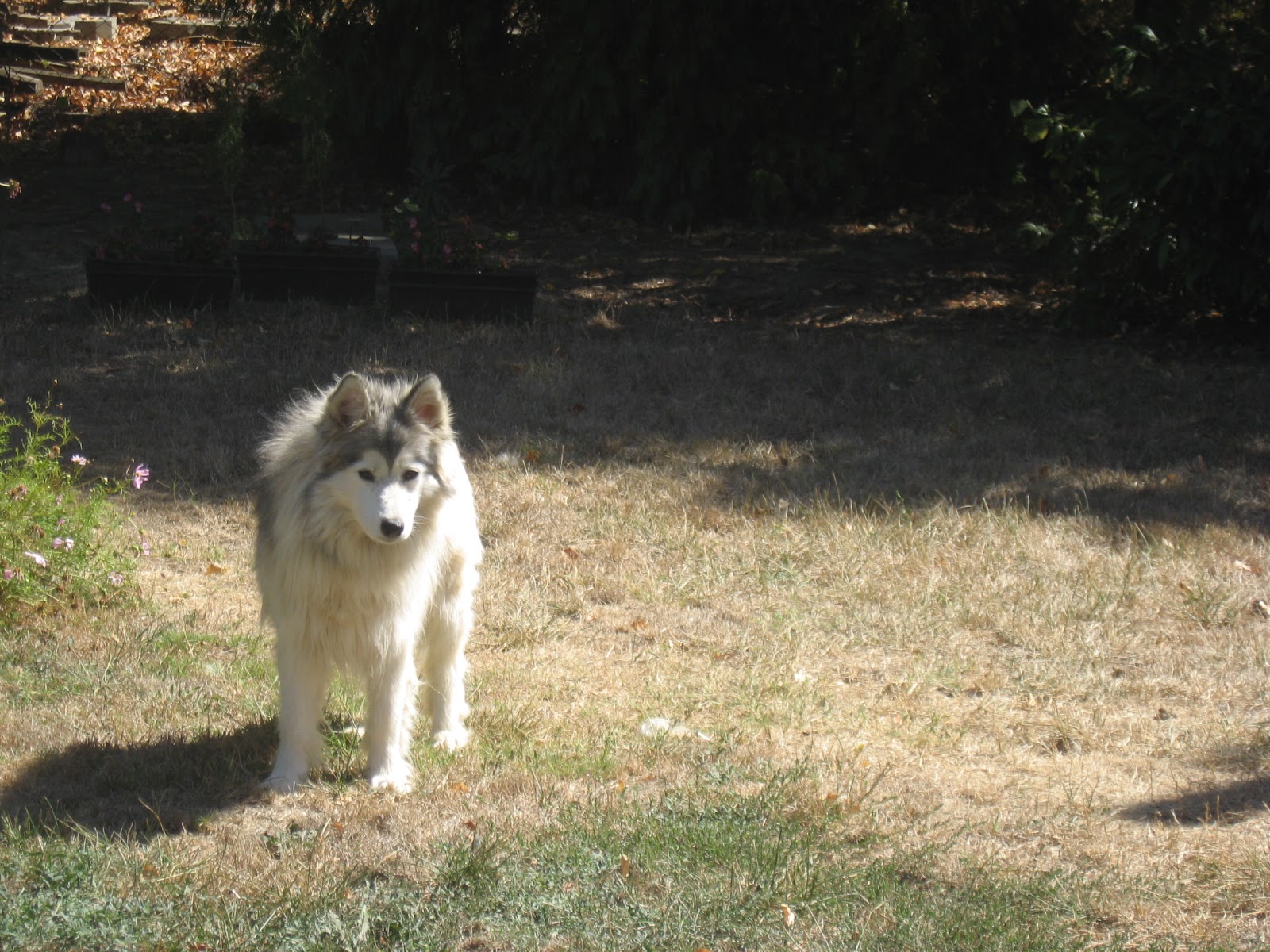
Meeting the dogs again

I haven't met our dogs since Christmas. Not that it wold be enough time for a dog to forget a family member. But our dogs our special. Special in this sense.
So, this is the expression one of our dogs made when seeing me again:


Notice: never, never did I yell at them or hurt them. We received these dogs from someone in the family who had an affair with dog breeding. Now, she wasn't the most responsible of all people in the world. Thus, the dogs, disregarding every taboo concerning such matters of delicacy, engaged in coitus in all possible combinations across the ladder of relatives. Thus, our dogs entered this pity plane of existence.


They are neat, strong and healthy dogs. They play with each other, hunt in the large garden and bell at other dogs. But they get frightened by everything. Would they escape if the front door would be open? Oh no, not them! Sooner would they close the door just to avert anything new and potentially scary coming in. A window gets shut by the wind suddenly? "Flee, you fools!" - their eyes say to me as the agony of fear deforms their little faces.
This general fright extends to me as well. As I'm visiting at home only a few times a year they consider me a special, unpleasant phenomena they have to endure from time-to-time. The only person they have a close relationship with is my mom who takes care of them. In their case having emotions towards my mom means that they don't run away from her and let her stroke their backs.
Nevertheless, I like the dogs. They make the garden vivid, they interact with us in their special way, eyeing me suspiciously all the time. As the days pass they come closer and closer to me. I like to feed them. This does not mean much for them, but I feel like caring for them.

We had wonderful dogs long ago. Social, funny, silly, crazy, talented, extremely clever and sensitive dogs. True leaders, great cowards. All sorts. They were all personalities. Now we have this lot, the five of them. And it's great they are here.


The sadness of travelling light

There are different types of travelers. Some do it for a few days or few weeks a year. Many of these short term wanderers only go because they feel it is expected of them. That this is the thing to do. That this is a way of impressing their partner. Or their friends and family. Others seek mini-adventures or enjoy educating themselves. They suck up experiences - no doubt, different ones. There are those hunting for pleasure, for romance, for beautiful sunsets and great food. One can hunt for museums, track sites of past events of great importance, visit shrines or look at architecture. All of these at once, non of these, or some.
But what I want to talk about is a different sort of travelling. This sort of travelling is for many people joyless and very instrumental. This sort of travelling is working abroad. Each year a fair share of my fellow countryman flock to the UK to earn some money. When chatting one of them told me "It is a shame I have to work here for money. But, the salaries are just so much better than at home!" He likes to befriend people from our country abroad. To eat food prepared in the same as at home. To spend his holidays at home. And after he has saved enough money he plans to go home to open a small pub, and if it goes well, later maybe also a brewery.
He does not want to live there. He is like a traveler, who has to be there, but is never at home.
Myself, I feel at home everywhere after a very shot time. I even find that I prefer England to my home country, although I wouldn't live in Scotland, not for the Dear Lord's sake! Except if I would move there. I think then I could get to like it and feel at home quickly.
In a sense I'm lucky to be here. I always loved travelling. That's what I spent my spare money on, that's what I wanted my job to involve. And now I have it. I'm not in the position many other from Central- and East-Europe are: I could have gotten a job in my field at home, I could have made a living. Of course if one is in research what matters is which particular institution one is working at and the UK has some of the best Uni's and research institutes in the world. That was a strong incentive to come here. But I never experienced this as having to give up something.
At the same time I can grow attached to places I live at. In the last ten years I lived in eleven different places. Except for one flat, I always felt sad to live. That a period was over. That a way of life, a sight you get when you open your eyes is never to come back. I also miss some of the people I lived together with.
Do I travel light? In Forster's A Passage to India Mr. Fielding claims he travels light. He does not mind giving up his home, his job, his habits and his friendship with Dr. Aziz when he leaves for England. For some time I thought I'm like him. That travelling and moving, changing places will always come easily. But I found that it doesn't. At the same time, I do not feel bound. And I lack a desire for a long term home. A strange position to be in, but one of those of us who are always on the road.

On Murakami's runner-book

Last weeks were busy, and besides work I also had some great art related experiences: a choir night at Exeter College's Chapel, visiting the National Gallery and an exhibition of Dali drawings and etchings.
But the latest one is that I have finally finished a book again, a book that is not related to my professional work. It is Harumi Murakami's book What I Talk about when I Talk about Running.
As usual the book is written in a very accessible and easy to read style. The vocabulary serves the authors' purposes well, it is not too repetitive. Although, I'm a bit doubtful about the role of the overtly conscious highlighting of the inter-connectedness of the main topics. We are constantly reminded of what the author is at present talking about, why he is doing so, why he thinks he should do so. As if he would need some sort of justification from us to do so. Or as if he would offer aids to the slower readers. I had the hunch that this might be a way of creating a certain atmosphere, but I'm nearly sure that he doesn't retort to such a cheap rhetorical devices. There are better ones, after all.
Murakami handles his topic with care and keeps the discussion of running sufficiently personal not to scare away non-runners. An interesting element is that he stresses many times the lack of stretching in his training, and experiences a gradual speed loss at the time of writing. Of course it is very possible that the speed loss is not the result of the lack of stretching, but one might wonder whether it couldn't do some good for those times.
Now back to the book: I'm always a bit puzzled by Murakami. I read his Norwegian Wood a couple of years ago. At that time I didn't like it. It was a very sad book, about young people lost amid cynics, amid the unexpected cruelty of the world and their own torrent of teenage feelings. Later I learned to like the book. It has a seriousness which I appreciate now, and often when thinking or talking about death, depression or loneliness scenes from that book come back to me as perfectly capturing instances of how ruinous such phenomena might be.
This is ever more puzzling for me, since Murakami's style seems very distant to me. Compared to English, French or American writers I know well - and also Hungarians - he is not personal. No matter whether he is talking about the way his characters feel or about his own transformation from bar owner into novel writer, he still keeps a distance one can feel.
This does not make the book less enjoyable. Maybe one doesn't establish the sort of relationship in one's imagination with the author as one does at other times. (I have a very special relation with Borges: I often imagine him, walking the streets of Buenos Aires, or how he reads, or listens to a reader) But then again, maybe Murakami doesn't want us to establish such a relationship with him.
I mentioned that the language the book uses is fairly simple. This is usually good, but sometimes it is overdone. Evidently, he could use more colorful descriptions, better allegories, symbols. After a time suspicion creeps in that he couldn't. This style is not the result of the influence of minimalism (Murakami translated some of Raymond Chandler's works into Japanese). This style seems sometimes to be the result of not being able to spot interesting connections between phenomena, not being able to tell which details of the world, which stories to tell about. It seems to be the very limit of Murakami's artistic talents. He cannot talk about certain things.
I felt this limitation very sharply when I read Coelho. Murakami is of course a much more interesting and refined writer, but on certain pages one meets the lazy-mans confusion about ordinary psychological or scientific phenomena. The lazy man covers this up with folk psychology, or cheap wisdom. Not that this happens often in Murakami. But it does, and this is bad enough. Coelho, on the other side, is even worse: he has nothing to offer but confusion and shallowness, and then he terms this 'sense of wonder' or 'magic'. Well, it is the sort of magic one might experience while watching the new episode of a sitcom every week.
Murakami is also confused about human nature: at points he emphasizes that we are the collections of character marks, which are our dispositions and cannot be altered. At other times he stresses the importance of using our will to achieve things. We could employ an extremely charitable reading to understand this as meaning that those of us who are disposed to use their willpower should do so. But this is still a bit confused: what else could they do, after all?
What struck me as great in the book were the parts where Murakami describes actual races, days from his life, hints at his complicated but deep relationship with his wife and talks about the phenomenology of running and swimming. These parts are the salt of the book: here Murakami has material to tell us about, here he shows that he is great at giving a taste of real experience in a condensed style. His story about running his first full-length marathon from Athens to Marathon, under the scorching Sun, or the way he summarizes what he feels to be the gain of engaging in long-distance running are great pieces of writing.
These parts of the novel are the ones that show the greatest likeness to those haunting moments of Norwegian Wood. Stark, clear scenes, where what is captured most forcefully is how a person senses a challenge, that some things are against him or her, and has to face them alone.
If one is the type of person who is concerned with the difficulties his or her life keeps in stock for one, if one likes long-distance running, or if one is a fan of Murakami one can like this book. Maybe I'll like it more later, like it happened with Norwegian Wood. Right now it was just a quick, nice read at the start of my holidays. I'm looking forward to enjoy the famous international chamber music festival of Kaposvár (Kaposfest), visit the Rippl-Rónai villa (and read a book about his paintings by István Ghenton) to visit Budapest for a few days and to go for some wine tasting in Pécs.